(This is a post in response to my comments in the thread by @morbrorper on Review-sorting algorithms).
During my time playing Clozemaster I have come to realise that I often find that a large number of sentences in a collection require some degree of “pre-processing” before I can play them. Some of the issues that come to mind that I need to deal with include -
- Sentences for which the translation is simply incorrect
- Sentences for which the translation is too loose to be useful
- Clozes for which there are multiple possible valid answers based on the translation
- Clozes that I consider to be useless e.g. Tom, Boston, exclamations such as “Aaaargh” etc.
Dealing with these issues interrupts my rhythm and hence nowadays I prefer to go through a collection and deal with these issues all at once before playing the collection as normal using the spaced repetition system (SRS).
I should add here that there are some sentences where I like to stop what I’m doing and investigate some words or constructions or idioms etc. as part of the learning process, but this is part of what I enjoy about language learning and these aren’t what I classify as “issues” - “issues” aren’t fun, they’re annoying!.
So, this is the method that I use to pre-process a collection before I play it normally (i.e. using the spaced repetition system with appropriate review intervals).
N.B. - Note that because we are going to change the “Default Review Settings”, we can’t play other collections unless we go back into this settings menu and set it back to our preferred spaced repetition system options.
Also note that this wouldn’t be an issue if we had an option to set collection specific review settings as was requested 4 years ago by @LuciusVorenusX (@mike said it’s on his radar  ) -
) -
My Method
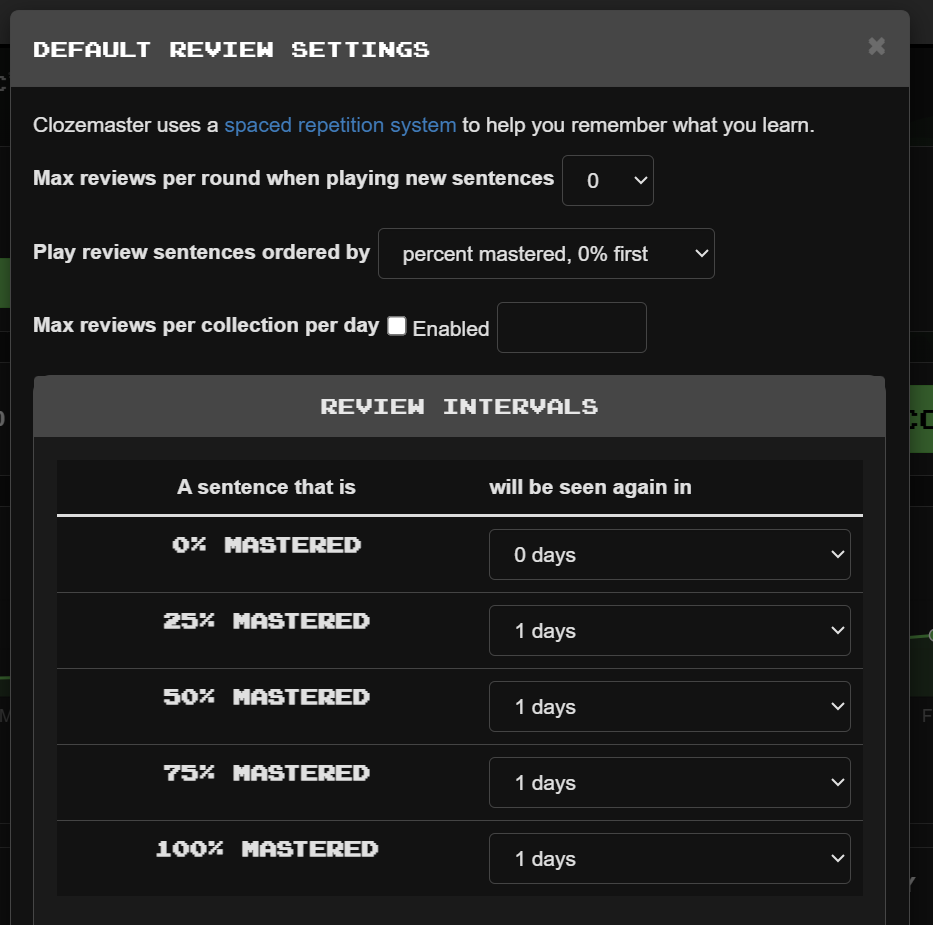
Firstly I set the next review settings to be -
Max reviews per round when playing new sentences → 0
Play review sentencces ordered by → “percent mastered, 0% first”
Review intervals 0/25/50/75/100 will be seen again in days 0/1/1/1/1
Here’s a screenshot of the settings -
Stage 1 - I go through all sentences in a collection in the “Play” configuration. If the cloze is “Dave”, “Boston”, “Aaaaagh” etc. then I will set the sentence to ignore (Alt-I on PC) as I have no interest in these clozes. If I know the cloze straight away then I set the sentences to known (Alt+K on PC), otherwise I use letter hints, multiple choice etc. to answer the cloze and then leave it at 25% complete. The 25% completion doesn’t mean that you know anything about the sentence at all, but it is just a marker that the sentence has passed stage 1 as “not immediately known”.
After this stage I have filtered out the more obvious clozes. For many languages there are a lot of “new” clozes that are obvious from the grammar of the language. For example plurals, regular verb conjugations, regular noun declentions, addition of affixes in agglutanitive languages etc. (I find that this can easily be 50% or more of the sentences in a collection for some languages).
Stage 2 - This is the time intensive (and sometimes boring, sometimes fascinating) stage. We are now playing “Review” on this collection, and all sentences have (in theory) the 25% completion “marker” indicating that they were not immediately known.
In this stage there are still some words that you can set to known if you so choose. For example, in a “most common words” collection there might be a cloze which comes up many times for a specific word translation. You might know several symonyms for that word but realise that this collection is using one of those symonyms all the time. In this case you could choose that - rather than add a hint to each occurence - you will simply set the sentence as known every time that you correctly guess the cloze first time.
For any sentence for which you don’t know the cloze you now use your favourite tools to examine the sentence or cloze. In my case that would include translation tools (Google, DeepL etc.), English Wiktionary and/or language-specific Wiktionary, Reverso (conjugator, context etc.), the Explain feature, and of course if there is a sentence discussion on these forums then that would be best of all.
You can then use your investigation to either add a hint, or else to change the translation itself to better reflect the sentence and cloze (or change the sentence and add a hint). In some cases you may wish to add alternative answers to capture valid symonyms/conjugations/declentions etc. For many sentences you will add nothing because the cloze is just a word that you have never seen before and the translation is an accurate reflection of the sentence.
At the end of this stage all sentences should be either marked as known or marked as 50% completion. The 50% completion “marker” signifies that the sentence has been processed to add hints or change the translation to something more suitable where appropriate.
Stage 3 - You now sweep through again. If you get the answer correct first time based on your hints or changed sentence then you mark the sentence as known, otherwise you answer the sentence to set it to 75% complete which indicates “needs more work after hints”. In my case there are many sentences where I get the answer correct but still let it pass through to 75% complete as I want to review it again.
Stage 4 - Go into review settings and set “Play review sentences ordered by” to be “percent mastered, 100% first”.
Now sweep through again.
If you are satisified with your hints or changed sentence (in those cases where you added hints etc.) but still don’t know a cloze then you reset the sentences to 0% complete (Alt-R on PC).
If you aren’t happy with your changed hints and sentence then this stage gives you a chance to review the sentence and hints. You then answer the sentence “correctly” which sets it 100% complete. Because of the changed play review priority this will mean that it will be played first in the first round of sentences tomorrow, so you can see whether you thought that your new changes were helpful (we can’t set review days to be 0 for anything other than 0% mastered, so we have to wait until tomorrow). When you are satisified with your hints and sentences you reset the sentence to 0% complete and continue sweeping through the sentences.
(At this point you have processed the sentences and you could jump to stage 7. The next two stages are just for additional practice on the most difficult sentences.)
Stage 5 - Go into review settings and set “Play review sentences ordered by” to be “percent mastered, 0% first”.
Sweep through the sentences again and either set the sentences to be known, reset (which means it will be played again in this sweep through), or 25% complete. Then after you have completed all sentences at 0%, keep going. On later passes (e.g. all 25% sentences) you will see any reset sentences immediately in the next round of sentences giving you additional practice.
Stage 6 - When you have gone through all sentences to set them all to known, or else are comfortable that there is nothing more that needs to be done for you to play that sentence in the future you can stop. You now have a “processed” collection, where you either have sentences for which you know the answer straight away or for which you have appropriate hints etc. to give you the best possible chance of answering.
Stage 7 (the final, and somewhat scary  step) - You now go into “Manage Sentences” for this collection and click that bright red “Reset Progress” button. This means that you will have to play all sentences again, including those for which you really did consider the answer as “known”, but any practice in your target language is good practice right?
  .
.
N.B. Make sure that you now go into “Default Review Settings” and set your preferred options including review intervals for spaced repetition system etc.
You now have a collection that is ready to be played as normal whenever you are read.
I’ll finish by adding that I am very appreciateive that Clozemaster has such a flexible system that I am able to do this. Amongst the features that this relies on are flexible review interval settings including choice of review priority algorithm and days to next review, sentence hints, ability to change the translation, adding alternative answers, resetting progress, marking sentences as known/ignore/reset (or through the edit sentence interface any other %age complete) etc… I would appreciate even more (such as per-collection review settings), but I consider the choice of options that we already have to be quite excellent.