A few weeks ago I noticed that in Spanish and German there are now sets of collections under the title “Skill Levels (CEFR)”. I therefore decided to choose one of those languages and play some of the sentences in these collections. This is my brief review, but I would be interested to know if other people have played these collections, and if so then what are your experiences and opinions.
Firstly, in order to find that these sets of collections they are available on the Collections tab immediately below “Fluency Fast Track”.
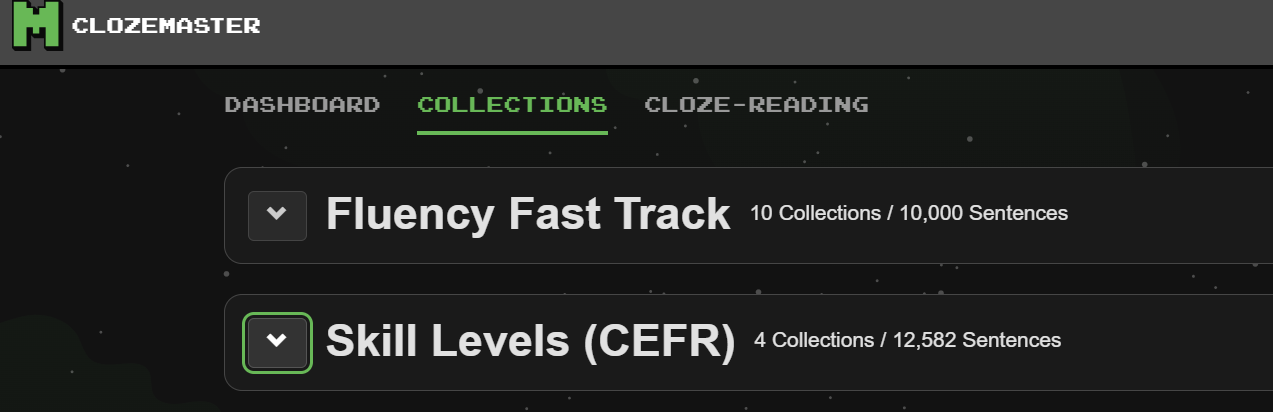
The collections are arranged in CEFR skill levels A1/A2/B1/B2.
(For anyone not familiar with CEFR (Common European Framework of Reference for Languages), this is a language competence classification system that was established by the Council of Europe.)
In these collections, each skill level offers somewhere between around two and four thousand sentences, with more sentences in the higher CEFR levels.
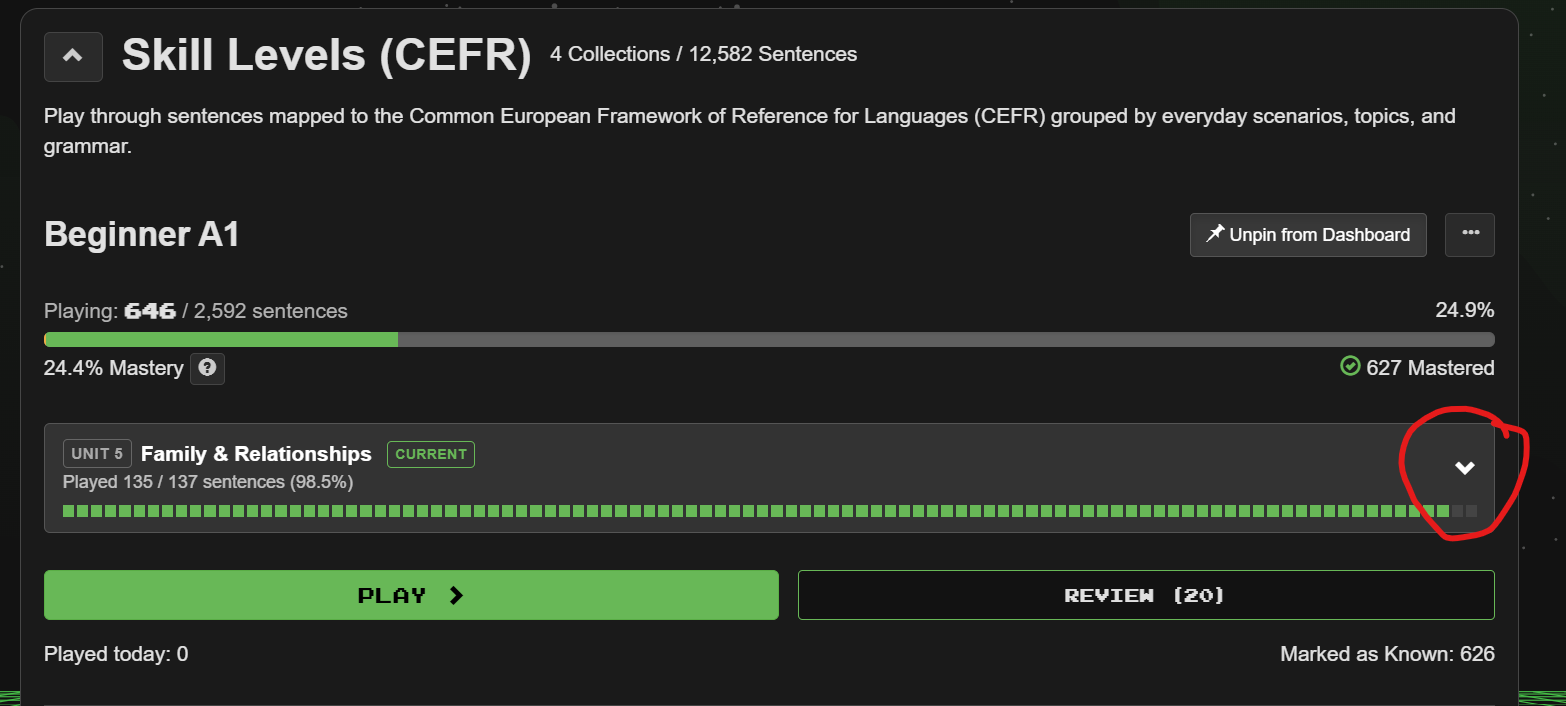
Apart from aligning these collections around the CEFR levels, the other new feature of these collections (well, new to me  ) is that each CEFR level’s collection is split into “sub-collections” with a subset of the sentences arranged around some common theme. To see the list of themes you need to click the small down arrow at the side of the collection (circled in red in this image) -
This will then reveal the full list of sub-collections for this CEFR level, and each sub-collection can be played individually.
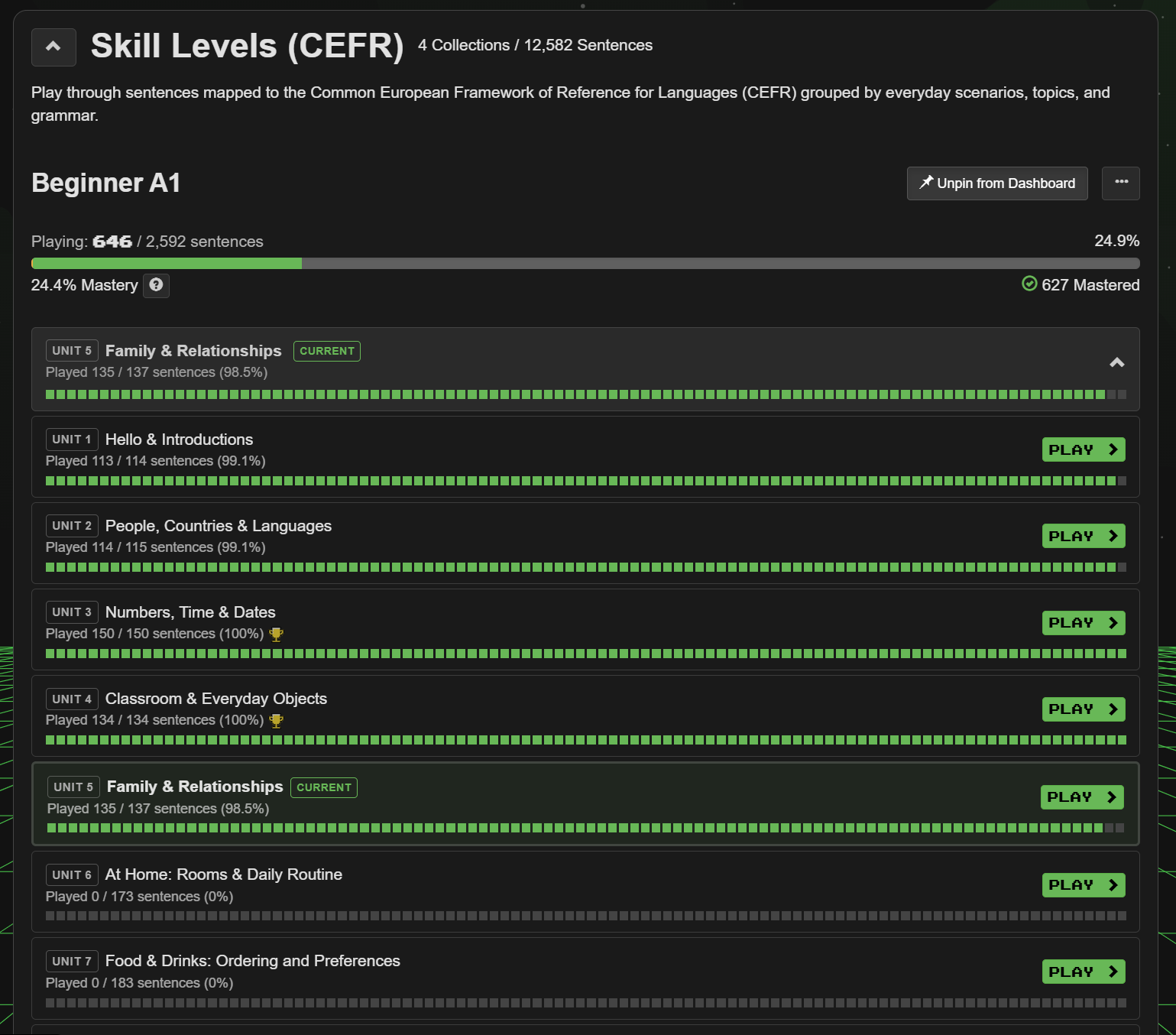
The sub-collections consist of between around 100 and 200 sentences each.
For the lower levels, these themes are generally centred around common situations such as introductions/numbers/countries/family etc.
In the higher levels the themes might be based around some grammatical feature instead.
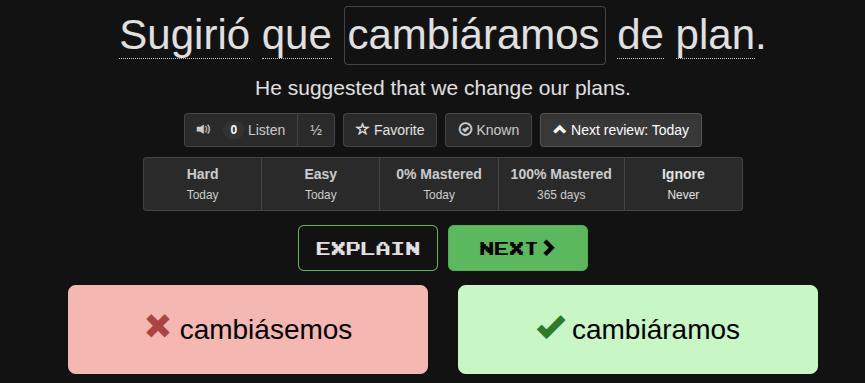
For example one of the German B1 sub-collections is based on forming the perfect tense with auxilliaries. In German a verb will use one of two auxilliary verbs sein (to be) or haben (to have) to form the perfect tense. So for the sentences in this B1 sub-collection, the student needs to decide whether the main verb forms its perfect tense with sein or haben and then conjugate that auxilliary verb.
Now I should state that I don’t know how these sentences were generated, or what system has been used to classify them into particular CEFR levels. However, that doesn’t really bother me too much, as most of the sentences (and translations) seem to be accurate, and themes seem to be reasonably well organised into collections based on whether someone is a beginner or intermediate.
With that disclaimer, I will say that I very much like the idea of these collections as an addition to the options available for learning. The Fast Track and Common Words collections in Clozemaster are primarily just sets of unrelated sentences, so I appreciate this addition of collections based around CEFR levels with a selection of themes such as might be used in a textbook or classroom learning situation.
For German (and Spanish) my main learning in Clozemaster will still be heavily based around the Most Common Words collections, but as an occasional supplement for specific topics (i.e. specific sub-collections) I could see myself making use of these CEFR collections. Furthermore, if this is extended to languages that I am less familiar with then I could definitely see myself using such collections as a more primary source of learning.
I do have one issue that I would really like to see addressed though (well, I would probably say that for me to use these it would absolutely need to be addressed) -
The ability to play these sub-collections individually only applies to when you play them the first time. There is no option to treat these sub-collections differently after the first play, i.e. you can’t “review” a sub-collection, and you can’t reset progress on a sub-collection. Actions like reviewing and resetting can only be done at the full collection level e.g. at the level of Skill Level CEFR B1, not at the sub-level of “Past Events I: Perfekt in Real Stories”. Therefore, if you have played several sub-collections but would like to review and practice a particular theme, your only two choices are to play all sentences that you have already played in the CEFR level, or to reset the entire collection so that you can play the sub-collection again.
I would therefore really like to know from @mike or someone else whether it would be possible to add the feature to reset and to review these sub-collections separately.
One other small issue that I’ve noticed as well is that if I click ignore on a sentence/cloze, then this doesn’t affect the counts against the sub-collection i.e. the number of total sentences in the sub-collection doesn’t change so on the dashboard it appears as though there are still sentences to play. This is a minor irritation for me, but one that I hope could easiliy be addressed.
In summary, I think these collections are a useful addition to the resources available for learners, and I hope that similar collections might be provided for other languages in the future. For my personal situation though, I would probably only make use of these collections if each sub-collection could be individually reset/reviewed.
P.S. One other tiny issue is that when pinned to the dashboard, alphabetically these collections are ordered A2/A1/B1/B2 (A2 is “Advanced Beginner A2” and so comes first).
 .
.