The Explain feature has been invaluable/essential in my study of Turkish on Clozemaster.
It is now thoroughly and completely broken.
Please, please, please, change the prompt to the LLM in the Explain feature to what it was previously.
–
The output of the Explain command has recently changed. Sentences that already had an “Explain” output haven’t changed, this change only affects new output.
The old output from the Explain feature used to break down a sentence into parts and then explain each part separately.
The new output from the Explain feature outputs a literal word-for-word translation, and then breaks the sentence down one word as at a time.
In my ~50 years of language learning I have never once come across any teacher or authority on the subject who has claimed that using literal translations or immediately jumping to word-for-word translation is a better strategy than analysing sentences as a whole and deconstructing them into meaningful parts for further analysis. If Clozemaster has some modern research that provides a different viewpoint then I would be most eager to read it.
I also don’t recall anyone asking for the format of the explanations to change. I’ve seen some people say that they would like the option to regenerate some of the older explanations with the latest LLMs, but that doesn’t require any change to the prompts (and certainly not anything as drastic as this).
I use the Explain feature extensively for Turkish (I study many other languages on Clozemaster, but this is the only one that I really use it for),
To show what I mean by the new output being broken I’ll give some examples for Turkish. I’ll show one sentence from my Favorites that has an old style Explain output, and then 4 of the 8 new outputs that I just generated from a set of sentences that I just played (I played 20 sentences and wanted further help on 8 of those).
Here is the output of a sentence using the old Explain feature (i.e. Explain using the former prompt to ChatGPT) -
"Tom’un bize teşekkür etmesine gerek yok." - “Tom doesn’t need to thank us.”
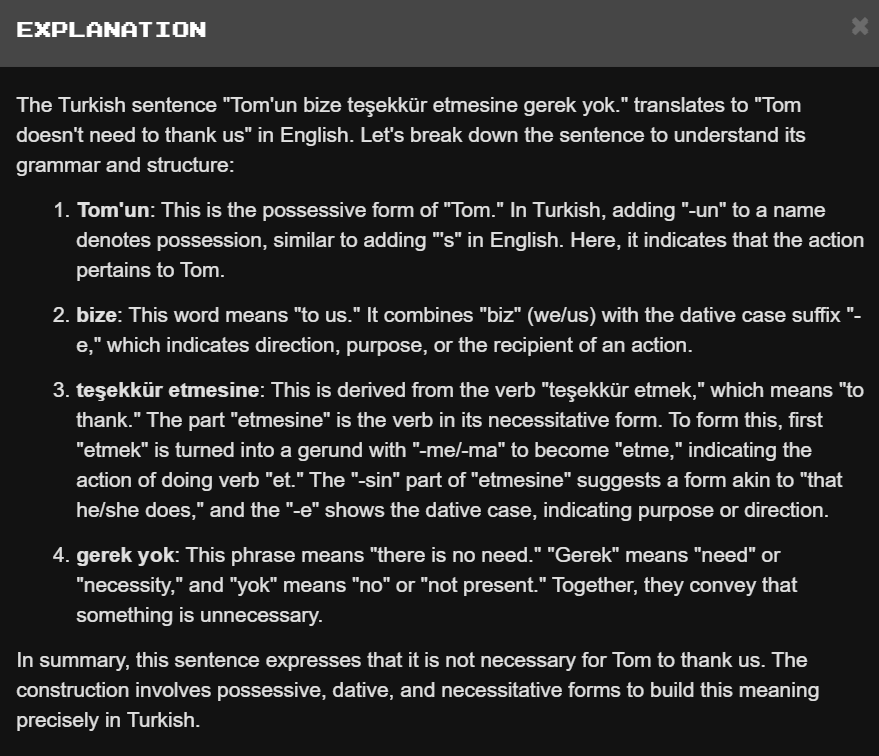
The explanation breaks the sentence into 4 parts. For the first two words in the sentence it explains the suffixes that are applied to each component. It then keeps together the compound verb teşekkür etmek and then explains why etmesine is in the form that it is with an explanation of each case ending. It then keeps together the phrase gerek yok to describe it as “there is no need” rather than immediately separating these parts into the more clumsy sounding “necessity” followed by “does not exist”.
I like this form of explanation. There are often bits at the beginning and end that are unnecessary such as here stating “this sentence expresses that it is not necessary for Tom to thank us” or a typical LLM introduction beginning with “Certainly …” etc., but these extra bits are harmless and don’t distract from the usefulness of the vocabulary and grammar explanations.
That was the old system, but it has now been taken away to be replaced by something that I consider to be far, Far, FAR worse. In fact, it’s so bad that I don’t want to generate any more of these outputs and hence polute the database until/unless it is changed to the old system, which means that I have to cease playing new sentences 

Here are some examples of the new “broken” explanations.
1.“Tom istifa etmeye ihtiyaç duyar” - “Tom needs to resign”
In this example there are 2 compound verbs istifa etmek meaning “to resign” and ihtiyaç duymak meaning “to need”, with both of these verbs having changed endings according to their grammatical role in the sentence.
Here is the output from the Explain feature with the literal translation and word-for-word translation -
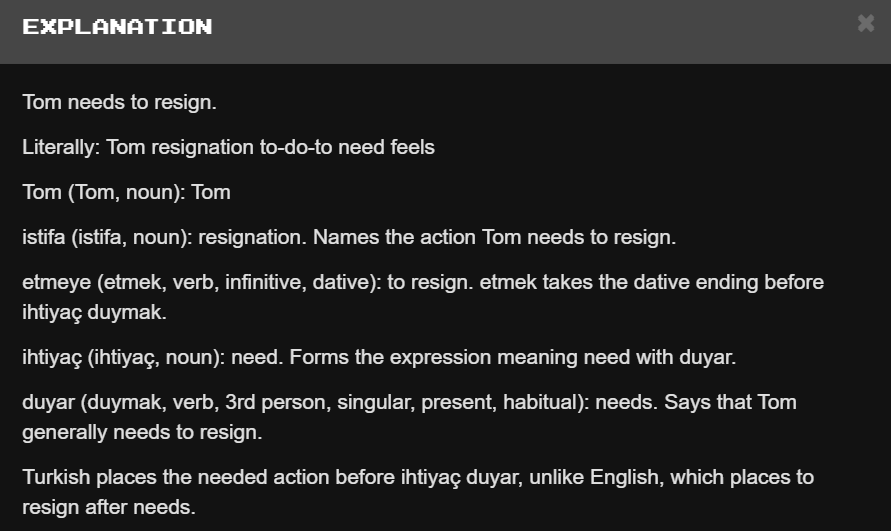
The output for etmeye claims that etmek means “to resign”, and the output for duyar claims that it means needs. Both of these are utterly and completely wrong. You can see from the literal translation that the LLM contains the knowledge that etmek means “to do” and that duyar means “feels”, but the forced breakdown below has produced this erroneous output. You can also see in the explanation after etmeye and the final sentence that the LLM contains the knowledge that ihtiyaç duymak is the complete verb. So the LLM has the knowledge to provide a good explanation … but the new prompt provided by Clozemaster prevents it from doing so 
2.“Onu sıcak bir mayıs öğleden sonrasında ziyaret ettim.” - “I visited him on a warm May afternoon.”
This sentence includes a compound verb ziyaret etmek meaning “to visit” which is conjugated in the simple past to become “I visited” (and hence the sentence does not contain the (implied) subject pronoun ben). The object of the sentence is onu which is the 3rd person singular pronoun (i.e. Turkish does not distinguish between he/she/it).
The rest of the sentence consists of the expression sıcak bir mayıs öğleden sonrasında meaning “on a warm May afternoon” which is built up as follows -
öğle - noon
öğleden - from noon (ablative suffix applied to noon)
öğleden sonra - afternoon
mayıs öğleden sonrası - May afternoon (possessive-style suffix sı added to sonra to say that the öğleden sonra is part of a compound noun with mayıs)
sıcak bir mayıs öğleden sonrası - a warm May afternoon
sıcak bir mayıs öğleden sonrasında - on a warm May afternoon (the locative suffix da added to sonrası to mean “on”, together with the connecting letter n)
Here is the output -
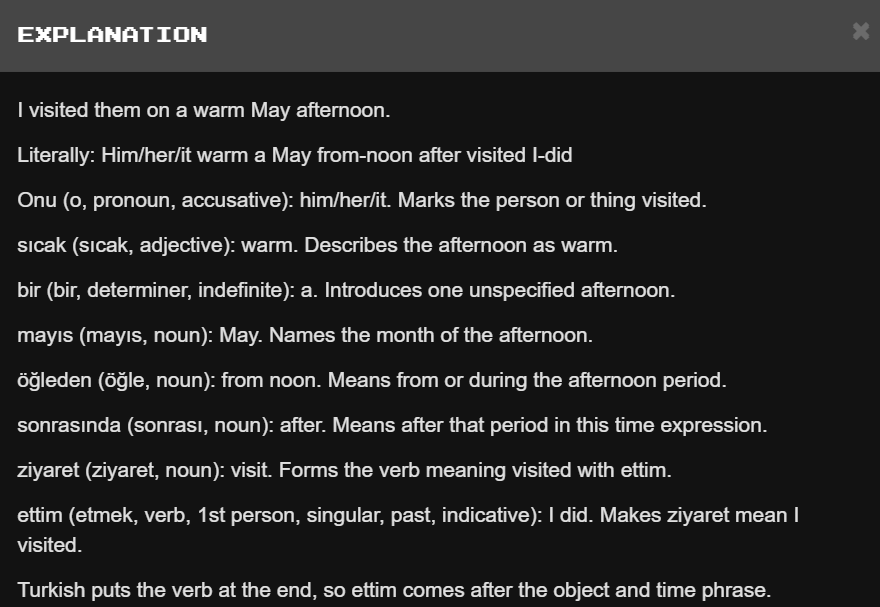
After the initial non-literal translation there is no mention anywhere of the use of the locative to say “on a warm May afternoon”, and the description for sonrasında mistakenly refers to sonrası as the root word and describes it as a noun (sonra is a postposition, although öğleden sonra could? be a noun  , but the LLM isn’t allowed to consider that), and it doesn’t give any help as to why it has the suffixes that together form the ending sında. Also note the difficulty that the LLM has having been forced to separate the two parts of the verb ziyaret etmek and it therefore tries to “glue” them back together.
3." Bugün öğle yemeğinde ne yedin?" - “What did you have for lunch today?”"
In this sentence öğle yemeğinde means “at lunch” (it could also mean “at your lunch”). It is formed as follows -
yemek - meal
ögle yemeği - lunch, literally “noon meal”(possessive-style suffix i added to yemek to indicate yemek forms a compound noun with öğle, and consonant mutation from k to ğ)
öğle yemeğinde - at lunch (the locative suffix de added to yemeği to mean “at”, together with the connecting letter n)
Here is the first part of the Explain output -
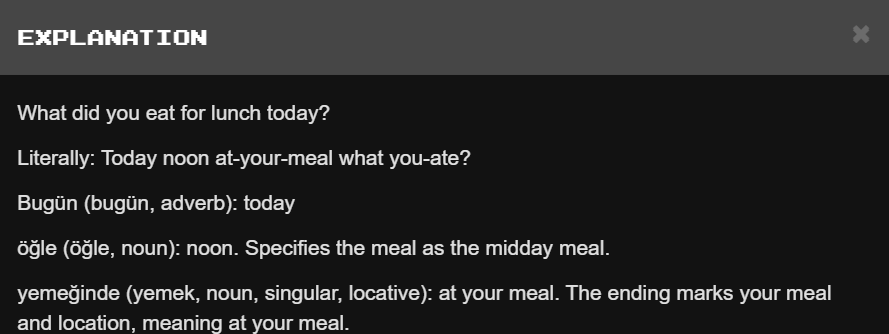
The initial translation can interpret öğle yemeği as “lunch”, but from that point forward it treats it as two separate words meaning “noon” and “at-your-meal”. It also has to interpret the in part of the suffix as the possesive marker for “your” because it has to treat the word in isolation (i.e. that is a valid interpretation, as on its own yemeğinde could mean “at/in your meal”).
4.“Kız kardeşim Yokohama yakınında yaşar.” - “My sister lives near Yokohama.”
In this case kız kardeş iş a compound word that means “sister”. Note in the output that follows how the LLM has difficulty describing the separate words, stating that kiz means “sister” when in isolation it only means “girl” -
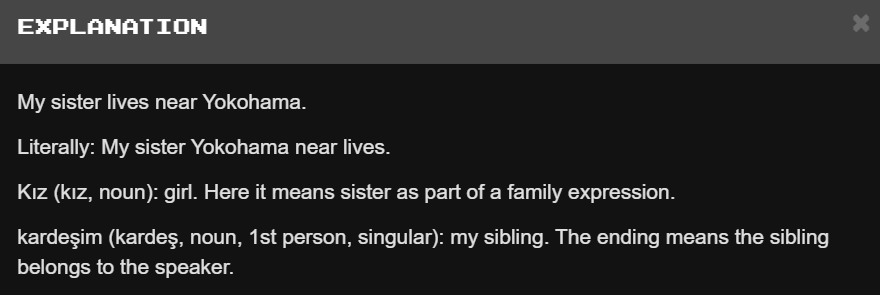
These are 4 examples from 8 sentences for which I just generated output. The others don’t really appear to be any better.
For example, one of the other sentences is a yes/no question using the Turkish yes/no question marker mi, but this particle doesn’t have a direct one-word English translation so the literal translation just throws the word “question” into the sentence and the word-for-word translation needs to pick something to use and so it translates it as “do”  . For another sentence the same problem of compound verbs comes up for the verb teşvik etmek meaning “to encourage” where the LLM isn’t allowed to keep the two words together as a compound verb.
I have no idea whether this is as bad in other languages, but most languages have phrases and compound words that need to be translated as a whole.
If anyone else has tried this on new sentences in other languages, I would be very keen to know what experiences you have had (N.B. of course you would have had to have read my ranting this far to be know that I’m asking for your feedback ).
I mean, how would this work for English learners with simple word-for-word translation of the dreaded phrasal verbs? 

 comment” section following “Explain” as often as possible in an effort to convince Mike&Team how much we need the old format to continue. Perhaps the more we Explain the better!