A few months ago there was an announcement on the Clozemaster sub-reddit about a new beta feature called “Discover” -
Playing Spanish from English? Give us feedback on a new beta feature in the web app! : r/clozemaster
This feature is only available for Spanish and to see the collections you need to first add an extra item ?include_discover=true to the URL for the Spanish from English page -
https://www.clozemaster.com/l/spa-eng?include_discover=true
and this will add a new Tab on the top of the Dashboard titled “Discover” -
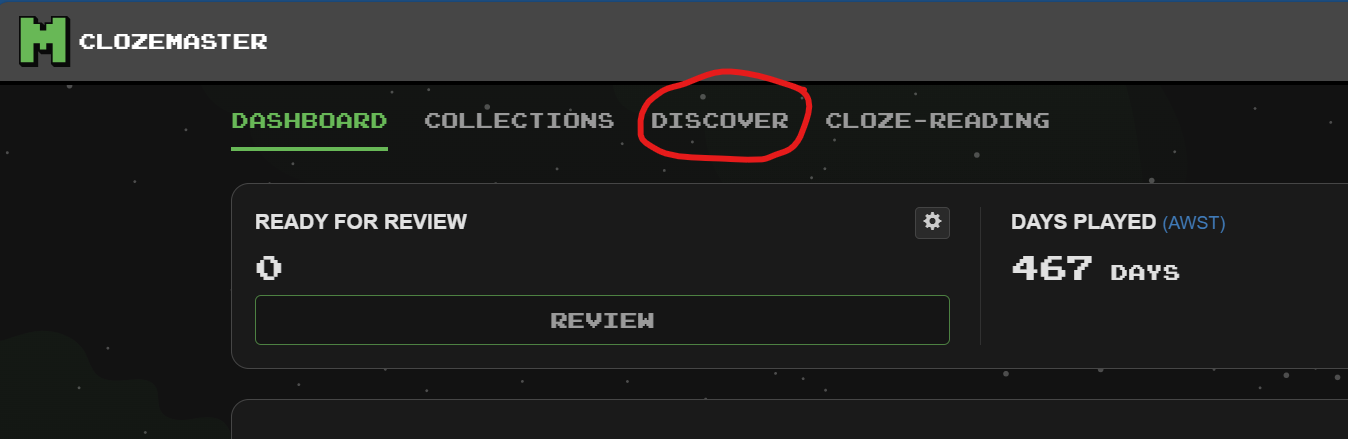
If you then click on this tab you will be presented with a page of 3 types of media materials - podcasts, short stories and songs - to choose from, with each media collection type sub-divided according to 3 CEFR level pairings A1-A2, B1-B2 or C1-C2. Currently there is only one of each media type available for each CEFR pairing (i.e. there are 9 items in total) with the other items flagged as “Soon!” -
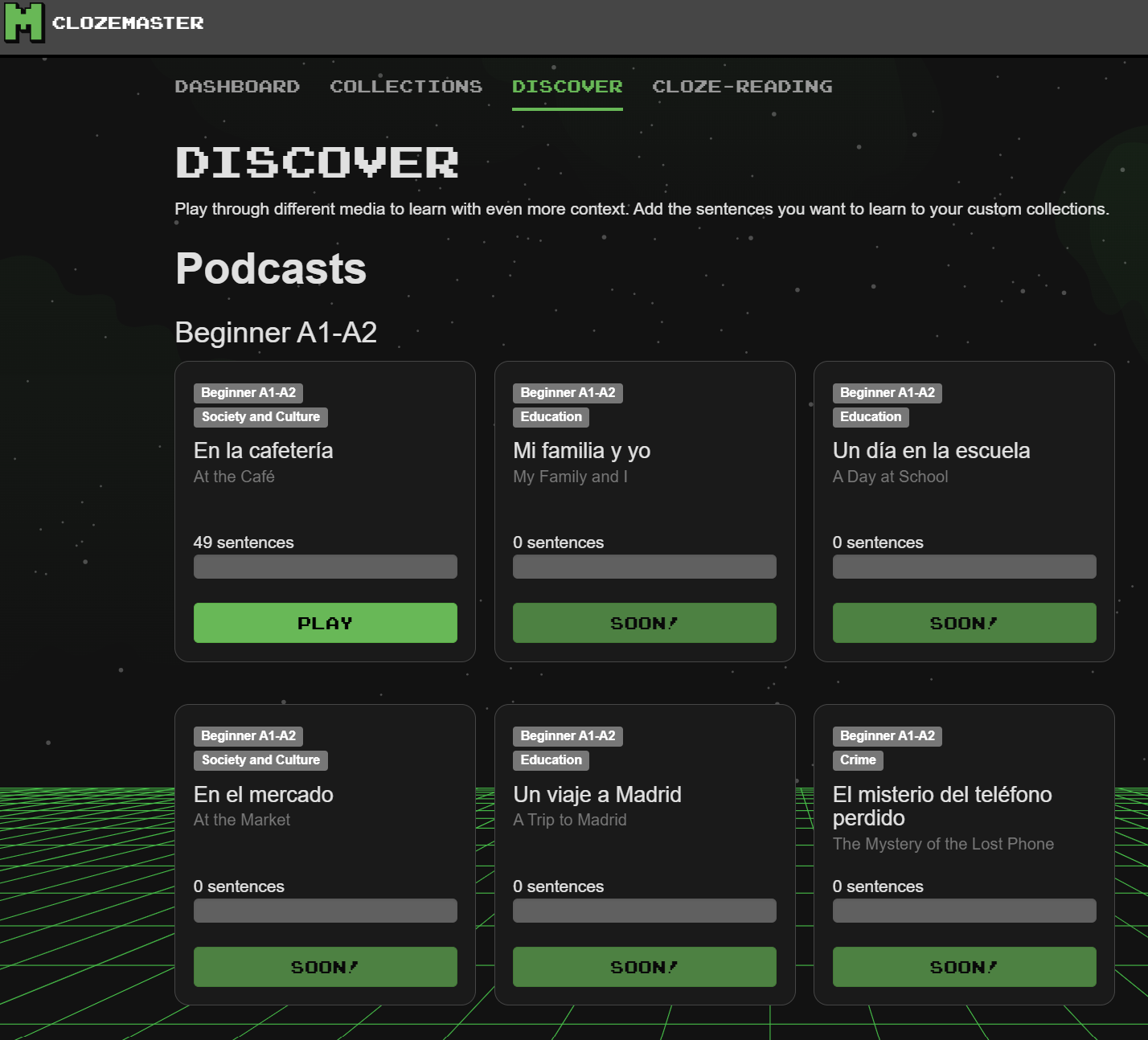
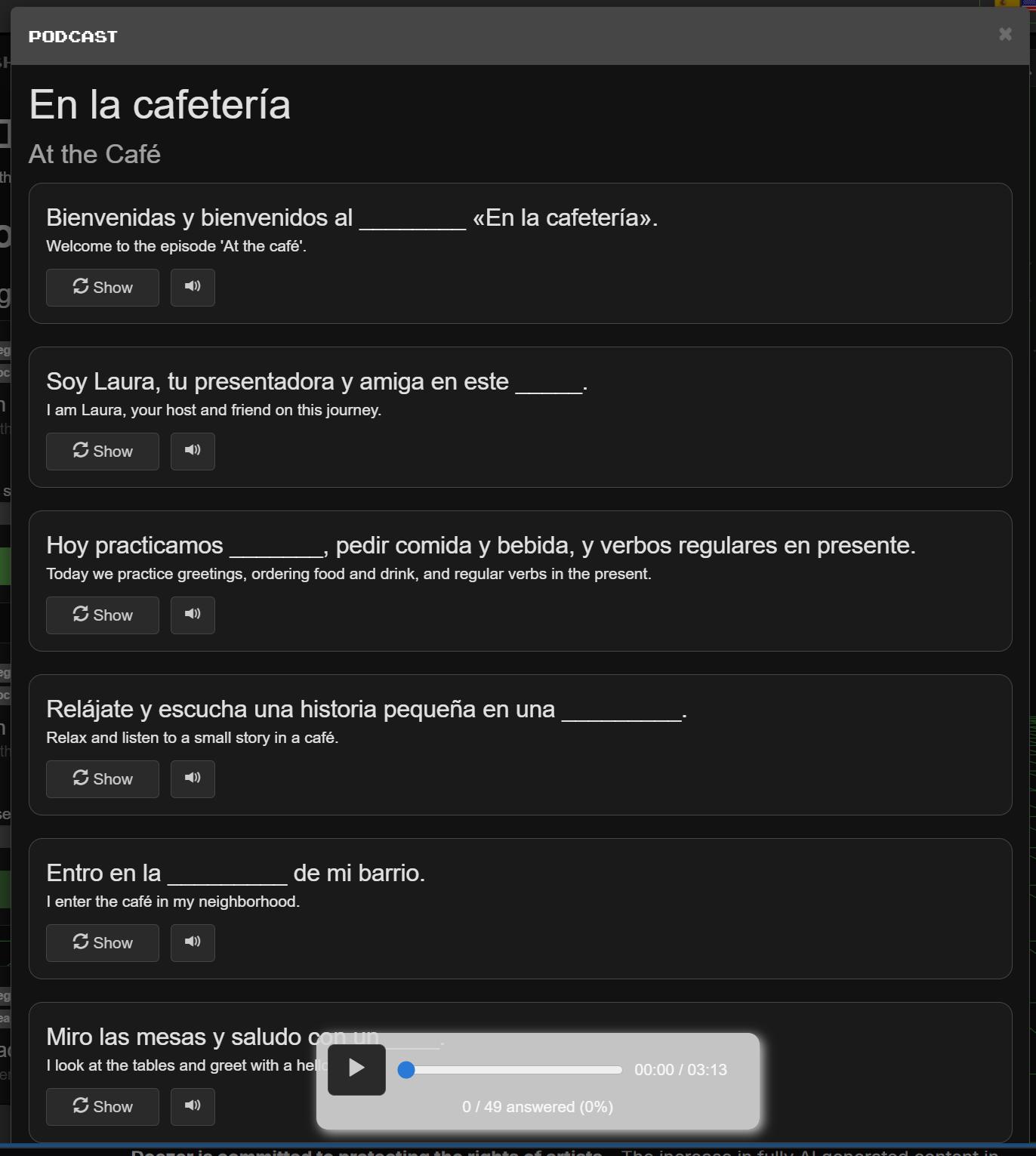
If you then click “Play” on one of the valid elements you will be presented with a list of sentences, each of which has a “Show” button to reveal the missing cloze word, and a speaker button to listen to that sentence.
At the bottom of the scrollable sentence list is a controller that you can use to listen to the full podcast/story/song.
Note that the voices used for the full show are different to those used with the speaker button for individual sentences (e.g. for the songs, the speaker button for a sentence does not “sing” the sentence).
This is an example showing the first of these media types, namely the A1-A2 podcast “En la cafetería” -
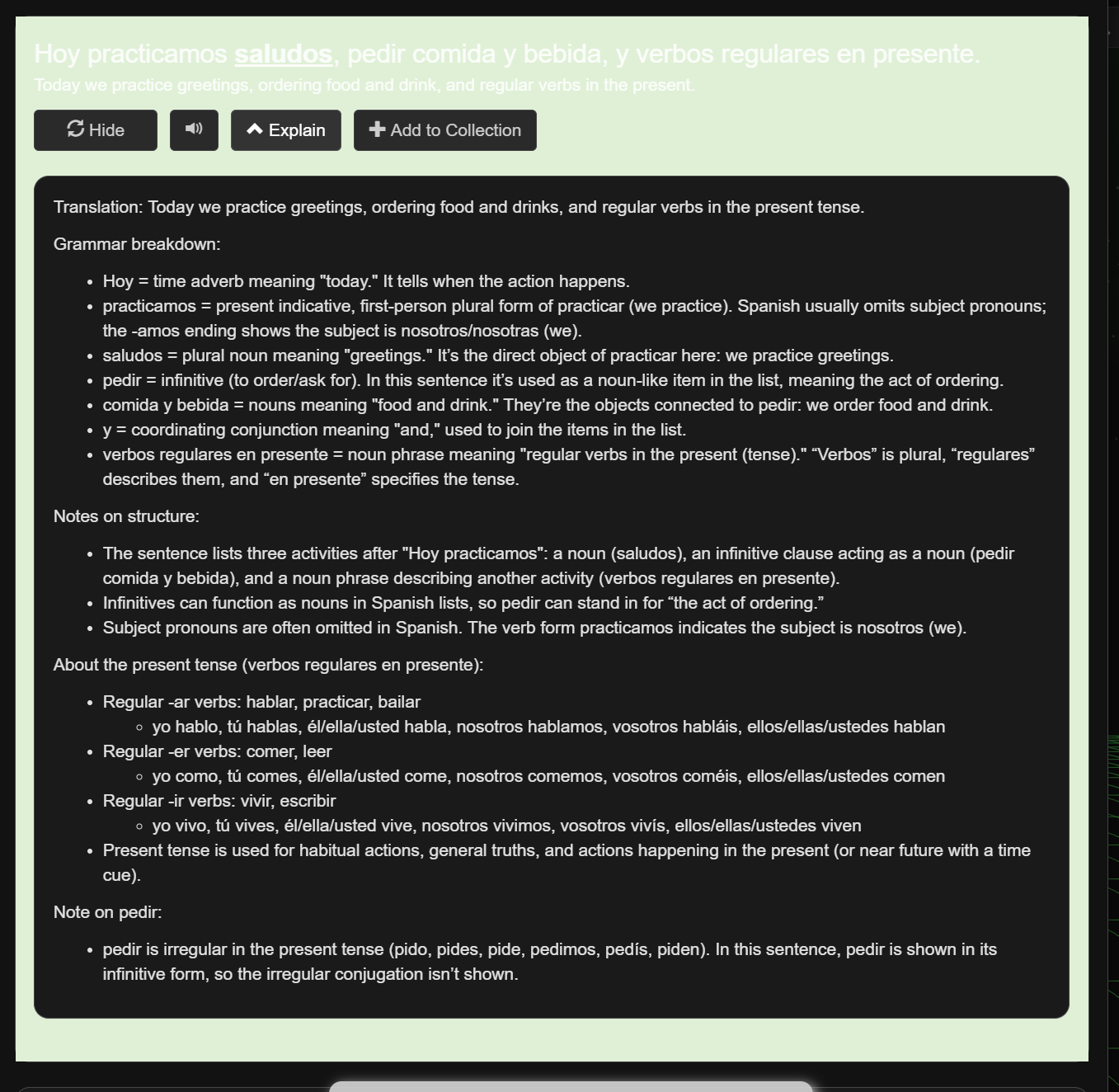
If you click on “Show” for one of these sentences then it not only reveals the cloze word, but also adds a button for the Explain feature and a button so that you can add this sentence to one of your own collections. Unfortunately, in dark mode clicking on “Show” makes the whole sentence almost unreadable with white writing on a light green background -

I note that the Explain descriptions had already been generated for all sentences that I clicked on, and for these sentences the Explain description seem to always be presented in a similar format with a translation, then grammar/vocab breakdown, then additional notes.
This is different from my experience with other collections (e.g. most common words) where the generated Explain format can be quite variable. For example, for those collections the feature sometimes begins with a response to the AI prompt and often finishes with a summary of where someone might see the sentence, but sometimes one or both of these is missing. Both of these features are missing in the sentences I clicked on in these Discovery collections (and personally I happy to not have those AI-related extras as they don’t really add anything to my learning experience). Also, for those other collections the description varies in that sometimes it might begin with a translation, and then describe the vocabulary and grammar, sometimes it offers a translation at the end of the description, sometimes it doesn’t offer a translation at all, sometimes it just lists the translations for each word and doesn’t add anything such as grammar description etc.
Here is an example of the Explain output for a sentence -
In terms of the content, the beginner and intermediate level material seems to be quite reasonable, and the way that this is presented in a podcast or story format means that there is a flow and common theme rather than just a collection of random sentences.
I will note here that when listening to the whole podcasts or songs etc., at least to my ear the errrm “narrators” or “singers”  often don’t seem able to stick to either seseo or distinción for the whole podcast/song.
So that accounts for the beginner and intermediate content, but when it comes to the higher level content, I would just invite anyone to scroll down to the stories section and click on the C1-C2 story “La paradoja del tiempo detenido”.
Oh dear. Oh deary, deary me!
Now I’m not normally someone to use the phrase “AI slop” … however, if there were an Olympics for AI slop, then this story would be a strong medal contender.
Here’s a sample -
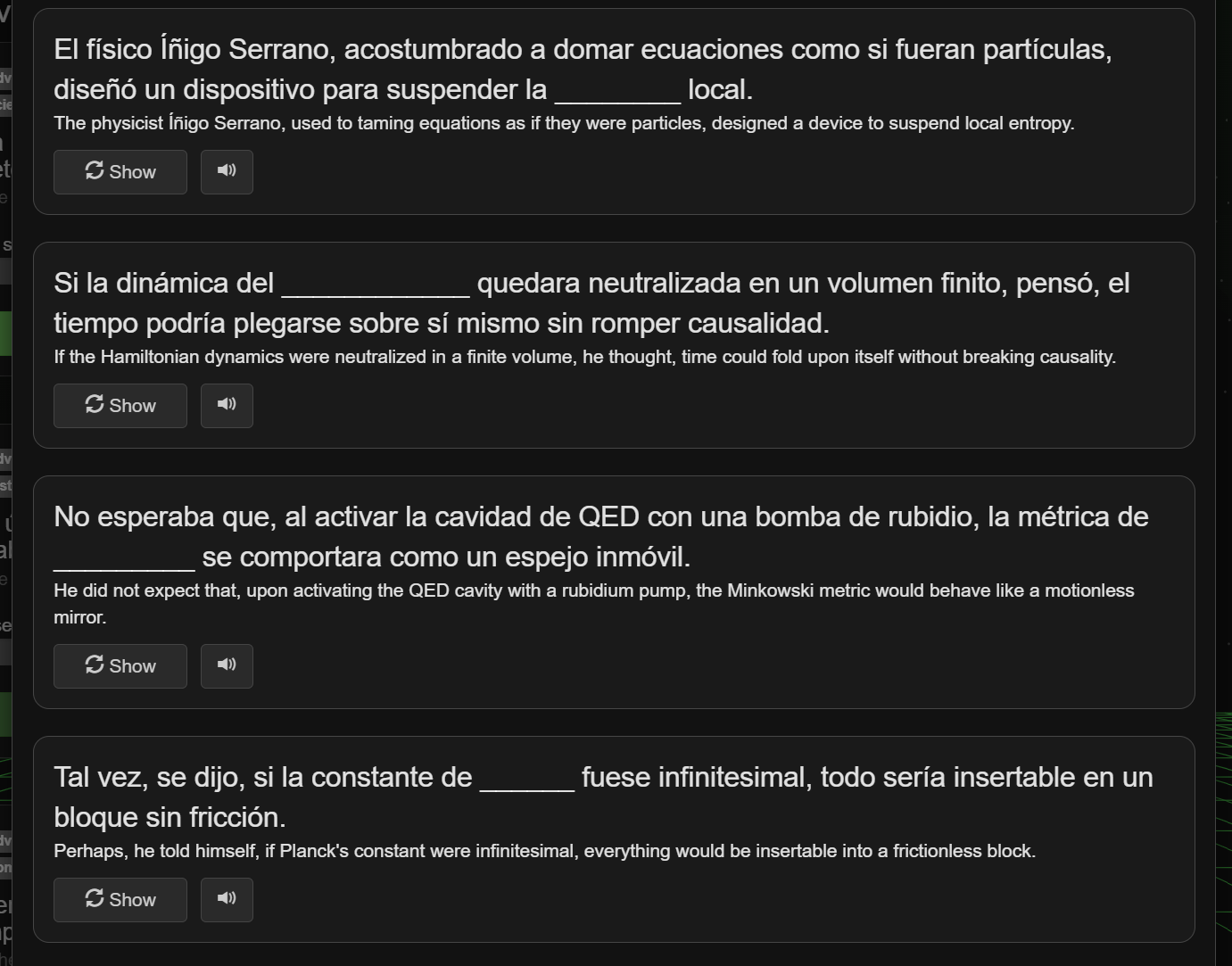
Apart from the story being complete gibberish, the choice of cloze words being scientist’s names is utterly useless (e.g. cloze words of “Hamiltonian”, “Minkowski”, “Planck”).
I’m not sure whether the problem here is trying to generate a science fiction story or trying to generate a science fiction story in Spanish, but whatever the problem happens to be the result is … now how can I put this with my British English understatement hat on … errrm, “sub-optimal”.
So, for the purposes of this brief review, I’m going to pretend that the C1-C2 content doesn’t exist (someone more knowledgeable than me might like to comment on the C1-C2 podcast for example), and simply say that I found the few examples of beginner and intermediate level material to be enjoyable to listen to.
Oh, and I did like the A1-A2 and B1-B2 songs  .
.
P.S. AI generated songs are now accounting for a very large amount of material uploaded to streaming sites, for example Deezer reported that it had reached 28% of all uploads by last September. This is now becoming a serious threat to the careers and livelihoods of aspiring musicians. In the case of these Discover collections however, I don’t think that it would be cost effective to hire someone to write and perform clearly spoken content that is graded appropriately to a specific CEFR level for a wide range of languages. Therefore, to my mind using AI for this type of material isn’t really competing with human artists in the same way as AI music uploaded to streaming services, and isn’t putting anyone out of a job as that job would never exist if someone had to be paid to do it.