The app seems to hardcode the number of repetitions to five (0%, 25%, 50%, 75%, 100%). It’s great that we can change the intervals between these repetitions but I find I just need more of them. I can’t see any way to change the number of repetitions but perhaps I’m not looking in the right place, it seems like a fairly obvious feature given the amount of controls Clozemaster provides for its SRS.
1 Like
When a sentence reaches 100% mastered, it will still be presented to you periodically, just not as often. Also, the period between repetitions is not a constant chosen by you but depends on (1) the last time you filled in the cloze correctly and (2) the option you chose from the review settings for handling sentences that are already 100% mastered:
For sentences answered correctly that are already 100% Mastered:
- Use an always increasing next review interval with Hard/Normal/Easy buttons after answering to modify the rate of increase
- Use Hard/Normal/Easy buttons after answering to set next review to 50/100/200% of 100% Mastered review interval setting
- Always use 100% Mastered review interval setting
The only way you’ll stop seeing a sentence is if you choose “Known” or “Ignore”.
2 Likes
After a sentence reached 100% (meaning you’ve answered it correctly four times in a row), it will from then on become due again every 180 days after you last answered it correctly if you use the default settings. So you’ll see the sentence every 6 months if you keep up with your reviews and don’t let them pile up.
You should reduce those 180 days to a number that fits your needs better. For example, the same number as the 75% setting (30 days by default). You can then further fine-tune how often you see 100% cards with one the three settings that @alanf_us outlined.
1 Like
I think the issue here is that some users, myself included, find that the current number of steps before reaching “100% mastered” are too few, and when a cloze reaches 100% it loses the preferential treatment and gets lumped with all the other clozes that are supposedly mastered.
Especially as you move towards higher levels and the clozes become more difficult, maybe even consisting of multiple words, only four steps to mastery is very limiting.
I try to deal with this by manually changing the percentage to get more steps before reaching 100, but it gets tedious in the end.
3 Likes
Here’s what works for me: I don’t shy away from resetting sentences back to 0%. This is quickly done by pressing the keyboard combination Alt and r if you’re practicing on a computer like I am, or by pressing the x icon.
Alternatively you can edit the percentages manually as @morbrorper does, which gives you a bit more control but is more time consuming. I prefer my simpler approach: Alt r and done.
These two approaches that I and @morbrorper follow are well described here and are how the Leitner system works:
In our digital age of applications, maybe it helps to remind ourselves of the analog methods we used before personal computers became ubiquitous. As I see it, you have two options with analog systems, such as paper boxes or plastic boxes:
- add ever more boxes if the given four or five don’t suffice, which quickly becomes impractical
- if a card reached the final box and you still don’t feel confident, move it back to a previous or even the first box
The first option seems to be what @patrickfatrick is asking for. The second option is what I and @morbrorper are currently doing, with differences in the details.
Clozemaster is a digital application, but it’s essentially equivalent to an analog Leitner system with five boxes: 0%, 25%, 50%, 75%, 100%.
With analog systems it was very hard to keep track of when individual cards would become due. You would only keep track of when an entire box (for example, the 100% box) would become due again. This is why digital systems were huge progress.
As I see it, with digital systems you have three approaches to solve the problem posed by @patrickfatrick, as opposed to the two approaches described earlier for analog systems:
- Use the newfound power of digital systems to fine-tune how often a card in the 100% box becomes due again, which is the approach I already described here. Following this approach, a card that has reached 100% will forever stay in the 100% box, unless of course you answer it incorrectly, and you come up with relatively sophisticated methods to automate when a card becomes due again. Again, see here. This is needlessly complex in my opinion. And why keep a card (100%) that you can’t confidently answer forever in the final box (100%) instead of moving it back to the first box (0%) as the Leitner system proposes? Just out of Clozemaster’s gamification aspect, since you would lose a chunk of your green progress bar and the percentage of the green bar relative to the yellow bar would decrease? And then come up with complex methodologies to work around that, instead of simply moving the card back to the first box (0%), just because you don’t want to see a gamification metric decrease?
- Add ever more “boxes” to the Leitner system as you seem to request. A digital system hides how impractical this would be, would you do it in an analog system. Imagine a Leitner box made of paper that has ten or 15 or 20 boxes. That would be laughable. Granted, the benefit of digital systems is that we no longer have to live under the constraints that analog systems imposed on us, but still … adding ever more boxes to the system seems, to me at least, needlessly complex when there’s the approach I describe next.
- Recycle the five boxes you have. Make more use of what you already have instead of wanting more. This is the approach I described earlier and that I and @morbrorper currently follow. A card reached the 100% box, but you still can’t answer it confidently? Move it back into the 0% box! Just press Alt and r. Or alternatively move it into the 25% or 75% box if you don’t mind manually editing the percentage. There’s no need for a card to remain forever in the 100% box. “Don’t get too attached to the gamification aspect and “progress reporting” of Clozemaster,” is my advice.
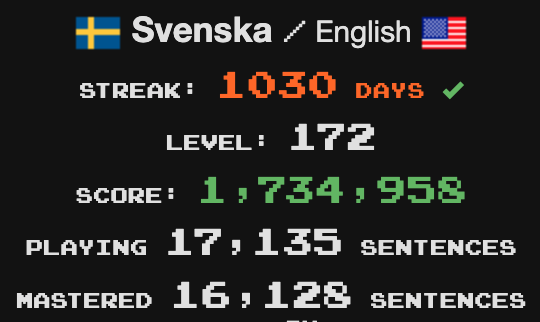
I’m quite content with my approach. Every few weeks I see a new topic like this right here being opened in the forum, asking how to increase the number of repetitions. I have never in my own practice had the problem described by @patrickfatrick or the annoyance felt by him. I just press Alt r to move a card back into the 0% box. If this makes the number of “mastered sentences” drop from 16128 to 16127 or the quotient “mastered divided by playing” decrease, so what?
3 Likes
My problem with that is that it would flood my review queue, especially now that I’m going through a huge review backlog after a long break. In order to keep the queue manageable, I reset to 75% instead; hopefully I will remember a few of them when they come up again.
1 Like
My review backlog is indeed quite large nowadays, but mainly because I have multiple other hobbies besides learning Swedish, and because I now dedicate less time to it than I used to, now that I reached the goal that I wanted to reach (master the 5000 most common words) and am now only on “maintenance mode” to prevent forgetting what I learned rather than continuing increasing my vocabulary.
I have configured Clozemaster to show me the 0% mastered cards first, then the 25% mastered cards, and so on.
If there are enough of 0%, 25% and 50% cards such that my allotted time for Swedish practice is over before I reach any 75% or even 100% card, then this means that I don’t practice a card as soon as it becomes due. But I don’t see that as a negative.
If the 30 days after reaching 75% are reached, but I don’t immediately get around to answering it, and get to answering it only after, for example, 43 days (13 days after it became due), then this actually saved me work. I want to wait as long as possible and review a card only when I’m at the brink of forgetting it. See the forgetting curve. If I review the card sooner, then I did unnecessary work that could have been avoided.
If I wanted to invest the time, I could try to find the optimal interval length by trial and error and experiment with the settings to see if a 75% card should become due after 30 days, 37 days, 43 days, 100 days, … But I don’t want to invest that time. I just leave the spaced-repetition settings on their default values (but I use the “always increasing next review interval” mentioned by @alanf_us here) and let the intervals be determined “naturally”. Let the chips fall where they may.
I don’t care about the size of my backlog at all. I ignore it completely.
- If I review a 75% card 13 days after it become due (after 43 days instead of after 30 days) and nonetheless could answer it correctly, good. I saved some work and cut my workload.
- If I review a 75% card 13 days after it become due and couldn’t remember it but would have remembered it, had I only reviewed it a few days sooner, tough luck. Back to 0% it goes. The 25% review the following day is probably unnecessary, and the 50% review after 10 more days probably too, but despite two unnecessary additional reviews, in the big picture I still save a lot of work with that approach compared to reviewing the 75% immediately when it became due 30 days after last answering it.
- If I let my backlog pile up so much that I review a 100% card only, for example, 360 days after I last answered it correctly instead of the default 180 days after I last answered it correctly, and could still remember it (which is often the case at this point of my practice) despite being way overdue, then I saved a lot of work. Which is good. I cut off an entire review cycle from my workload. This is exactly the idea behind spaced repetition and the forgetting curve.
This is just my approach, but it works well for me.
2 Likes
I never knew why the percentages were binned like that, it makes sense if it was inspired by a physical system. I’ve asked myself why couldn’t the % be anything between 0 and 100%. Then it would be trivial to adjust the bump you get on successful review to something else than +25%, or make it depend on how long it takes you to answer, or about anything imaginable.
2 Likes
I’m happy if my explanation could provide some insights.
Yeah, it’s not a continuous value that could be any number between 0 and 100. It’s rather a certain number of bins or boxes. If it helps, you can mentally rename “25% mastered” to “box 2”. There was a similar discussion about a year ago: